Introduction
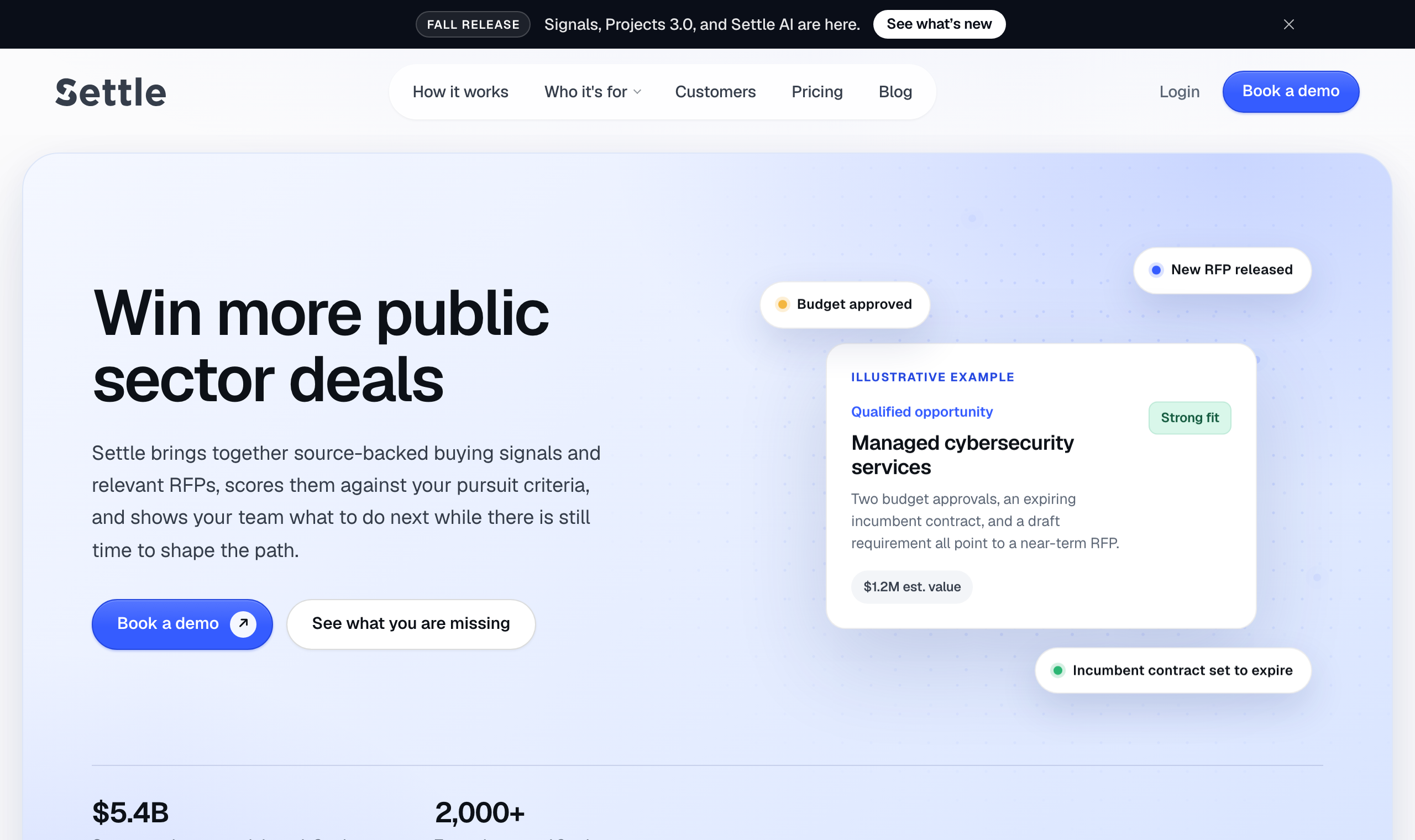
Settle is an RFP revenue and opportunity-intelligence platform built primarily for public-sector and SLED government sales teams (usesettle.com). Instead of waiting until a formal RFP lands on a public bid board, Settle monitors early procurement signals—such as approved government budgets, board agendas, approaching contract renewals, and expiring incumbent deals—scores each opportunity against your pursuit criteria, and hands qualified bids into a collaborative response workflow.
How Settle's Find–Respond–Review Workflow Works
According to Settle's live product documentation (verified November 2026), the platform organizes public-sector bid pursuit into three connected stages:
- Pre-RFP Signals & RFP Hunter (Find): Surfaces source-backed funding approvals, board minutes, renewal windows, and live RFPs 3 to 12 months before formal solicitation, pairing each match with AI fit analysis, issuing-agency context, and stakeholder contacts.
- Automated Proposal Drafting & Answer Library (Respond): Available on quote-scoped Core and Custom tiers, letting teams generate draft responses against a centralized Knowledge Hub and answer library rather than starting from blank templates.
- Team Collaboration & CRM Sync (Review): Core adds personal teammate views (up to 10 seats), a shared Review Inbox with comments, HubSpot CRM sync, Slack or Microsoft Teams digests, plus Apollo contact enrichment and Instantly email sequencing integrations.
Verified Pricing & Feature Gates (November 2026)
Unlike most enterprise RFP suites that hide every tier behind a sales call, Settle publishes a four-tier pricing grid at usesettle.com/pricing:
- Free ($0): Opportunity digest emails and 2 opportunity downloads per month. Does not include RFP Hunter search, Pre-RFP Signals, AI fit analysis, or proposal drafting.
- Starter ($99/month · 7-day free trial, cancel anytime): Up to 3 teammates, unlimited RFP Hunter search and downloads, Pre-RFP Signals, AI fit analysis, shared opportunity profile, and buyer research/tracking. Important boundary: Starter is a discovery and qualification plan—it does not include automated RFP response writing, an answer library, or HubSpot/Slack integrations.
- Core (Get a quote, scoped in demo): Up to 10 teammates, dedicated Settle signal tuning, HubSpot sync, Slack/Teams digests, Apollo/Instantly integrations, Automated RFP responses with your answer library, and Review Inbox.
- Custom (Custom pricing): Multi-team rollout, custom data sources/workflows, and managed opportunity tracking maintained by the Settle team.
Best Fit & Practical Boundaries
- Strong fit: GovTech, cybersecurity, IT services, media/marketing, and construction vendors bidding on state, local, education (SLED), or public-sector contracts who want visibility 6 to 12 months before an RFP is posted.
- When to consider alternatives: If you sell commercial B2B SaaS and primarily need automated InfoSec security questionnaire portals (OneTrust, Whistic, SIG/CAIQ spreadsheets) or rigid commercial Microsoft Word proposal templates, compare Settle against Responsive, Conveyor, and Qvidian in our 2026 Loopio alternatives pricing and compliance audit.
FAQ
How much does Settle cost?
Settle offers a $0 Free tier (opportunity digests and 2 downloads/month) and a $99/month Starter tier (7-day free trial, up to 3 teammates) for Pre-RFP Signals and unlimited RFP Hunter discovery. Core (up to 10 teammates) and Custom plans are quote-based.
Does Settle's $99/month Starter plan include automated AI RFP writing?
No. On usesettle.com/pricing, Starter covers Pre-RFP Signals, RFP Hunter search, AI fit analysis, and buyer tracking. Automated RFP responses with an answer library, Review Inbox, and HubSpot/Slack/Teams integrations are unlocked starting on the quote-only Core plan.
Who is Settle built for compared with Loopio or Conveyor?
Settle is built primarily for public-sector and SLED government sales teams that need to spot approved budgets and expiring contracts before an RFP is released. Teams focused mainly on commercial SaaS security questionnaires and Trust Centers typically evaluate platforms like Responsive or Conveyor.