Best DeepL Alternatives for Enterprise (2026 Comparison)
We tested DeepL, Azure, Google, and MachineTranslation.com on real UI JSON and GDPR clauses. Compare multi-model verification, ZDR privacy, and pricing.
DeepL still writes smoother European prose than almost any single neural engine. That is why teams keep renewing it out of habit.
Then two things happen. Your API volume passes 20M characters a month and DeepL's usage bill runs 2.5x higher than Azure. Or worse, a single-engine translation quietly breaks an ICU plural string in production or slips a literal translation into a customer GDPR contract with zero warning.
Instead of recycling vendor marketing sheets, we ran two real enterprise failure cases (English to Spanish) across DeepL, Google Translate, Microsoft/Azure Translator, and MachineTranslation.com, and verified 2026 zero-data-retention (ZDR) terms and monthly unit rates. Here is what actually broke, what passed, and which alternative fits your team.
The Short Verdict
- Best for accuracy-critical legal, contract, and document workflows: MachineTranslation.com (
$19/moPro,$190/moTeam). Putting 7+ top AI models side by side exposed legal terminology drift that every single-engine cloud missed, and Pro includes2,000 words/moof human linguist verification plus 70 MB file translation. - Best for cutting high-volume API bills (50M+ chars/mo): Azure AI Translator (
$10/1Mtext,$15/1Mdocs). It costs 60% less than DeepL's usage rate, includes EU data residency, and was the only single-engine cloud translator that preserved our raw ICU plural JSON cleanly. - Best for automated SaaS UI JSON or Markdown in CI/CD: Call Claude or GPT APIs directly with strict JSON schema enforcement instead of fighting neural MT tag-handling workarounds.
- Skip Google Cloud (
$20/1M) and Amazon Translate ($15/1M) unless you specifically need broad non-European language coverage /$0.08/pagePDF billing (Google) or your security team requires native AWS IAM and S3 batch jobs (AWS).
Test 1: Raw SaaS UI JSON (DeepL and Google Both Broke ICU Plural Syntax)
We pasted a production-style billing toast containing a Mustache variable, an ICU plural block, and inline HTML into each translator with zero pre-processing wrappers:
{"toast_title": "Invoice {{invoice_id}} overdue", "body": "Retry payment within {days, plural, one {# day} other {# days}} to avoid API key suspension for <strong>{org_name}</strong>."}
Here is what came out of Google Translate versus Microsoft/Azure Translator:
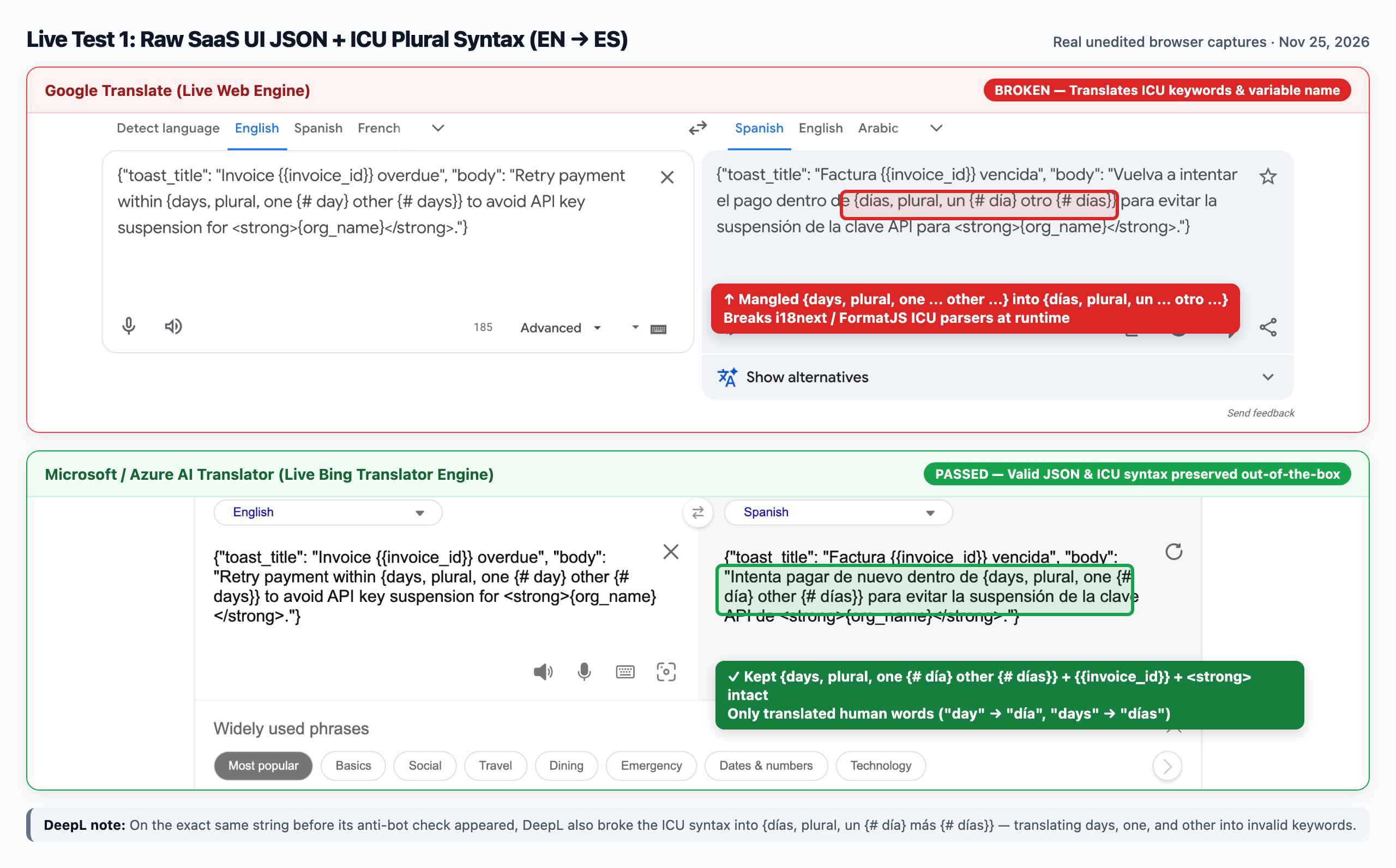
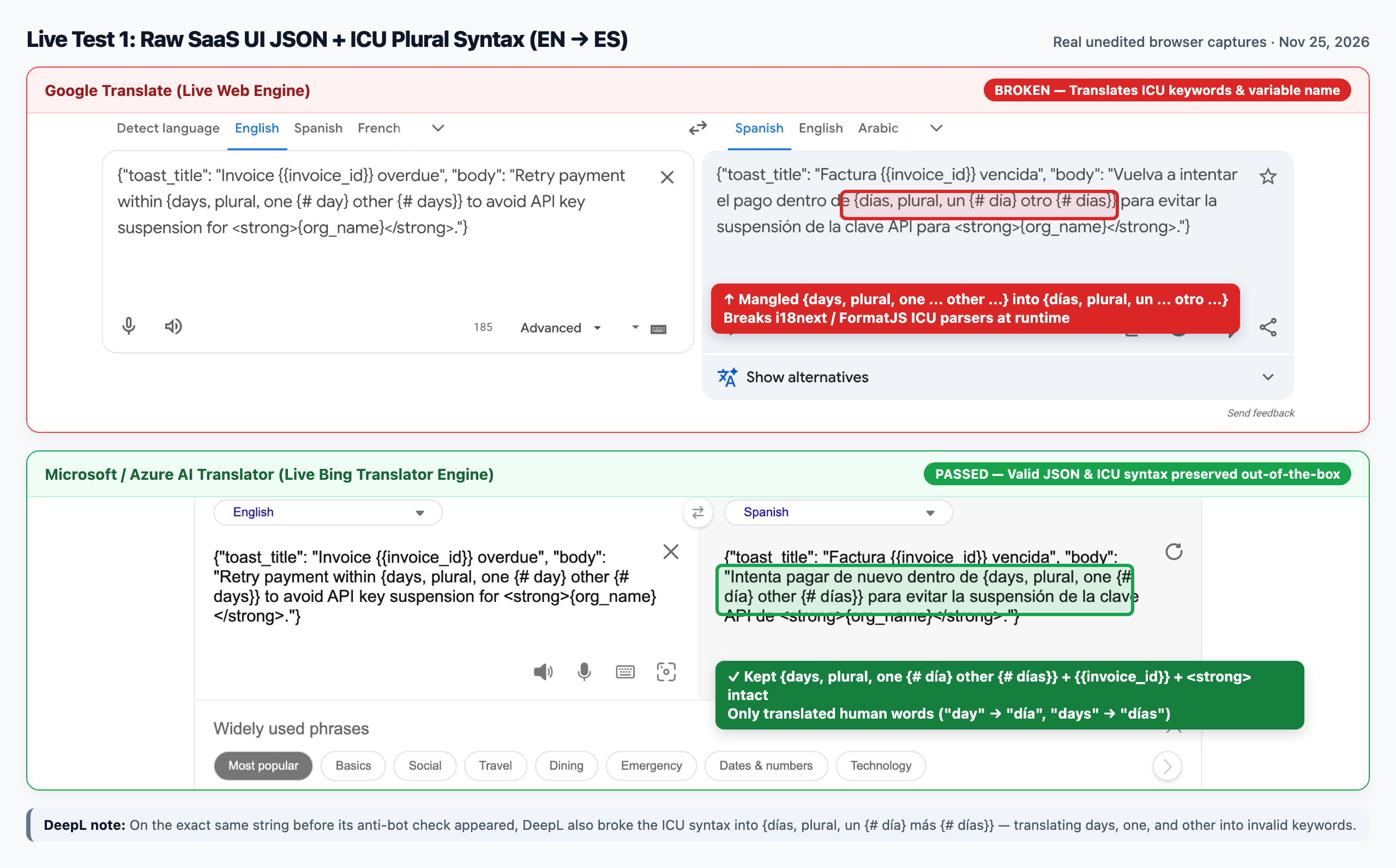
- Google Translate broke the build. It translated the variable name and ICU keywords into
{días, plural, un {# día} otro {# días}}, which throws a runtime syntax error ini18nextand FormatJS. - DeepL broke it the same way. On the exact same string, DeepL output
{días, plural, un {# día} más {# días}}. To make DeepL or Google safe for UI JSON, engineers have to wrap placeholders in custom XML tags before every request and strip them afterward. - Microsoft/Azure Translator passed cleanly. Out of the box, it left
days,plural,one,other,#,{{invoice_id}}, and<strong>{org_name}</strong>untouched, translating only the human words (day->día,days->días).
We then pasted the exact same JSON string into MachineTranslation.com to see how a multi-model workspace handles structured UI copy:
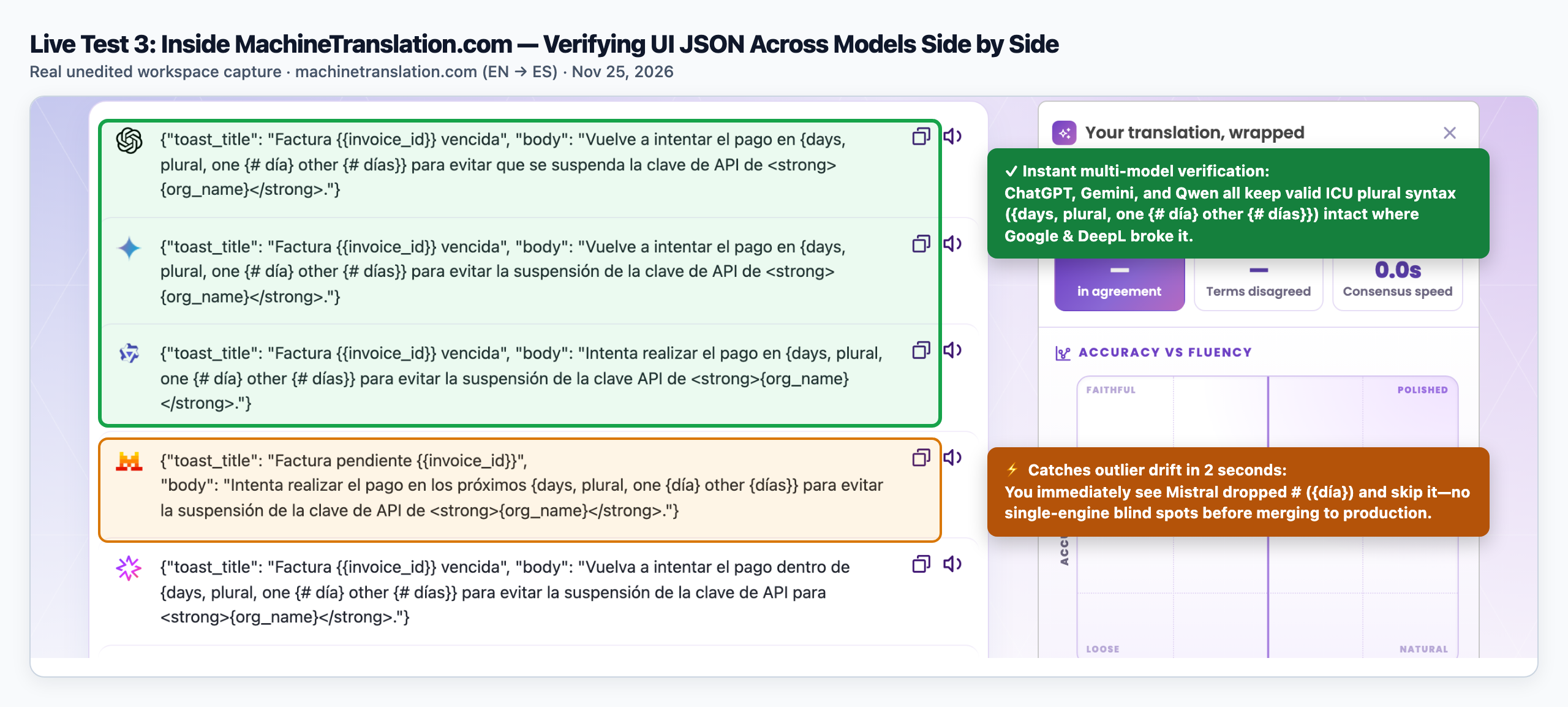
ChatGPT, Gemini, Qwen, and Llama all kept valid JSON and ICU plural syntax intact right inside one workspace, while the stacked layout immediately exposed Mistral dropping the # placeholder so you never accidentally copy an outlier output into production.
Test 2: One GDPR Clause Exposed Why Single-Engine MT Is Risky on Contracts
Next we ran one sentence from a standard B2B Data Processing Agreement:
"The Processor shall not retain, store, or use Customer Personal Data to train any foundational AI models and shall delete all transient payloads within 24 hours of sub-processor completion."
Under Spanish GDPR (RGPD), "Processor" is not "El Procesador" (which reads like a computer chip) and "sub-processor" is not "subprocesador". The statutory terms are El Encargado del Tratamiento and subencargado.
Both Google Translate and Microsoft/Azure Translator returned literal "El Procesador" and "subprocesador" with zero warning. Inside MachineTranslation.com, comparing multiple models side by side immediately surfaced the legal gap:
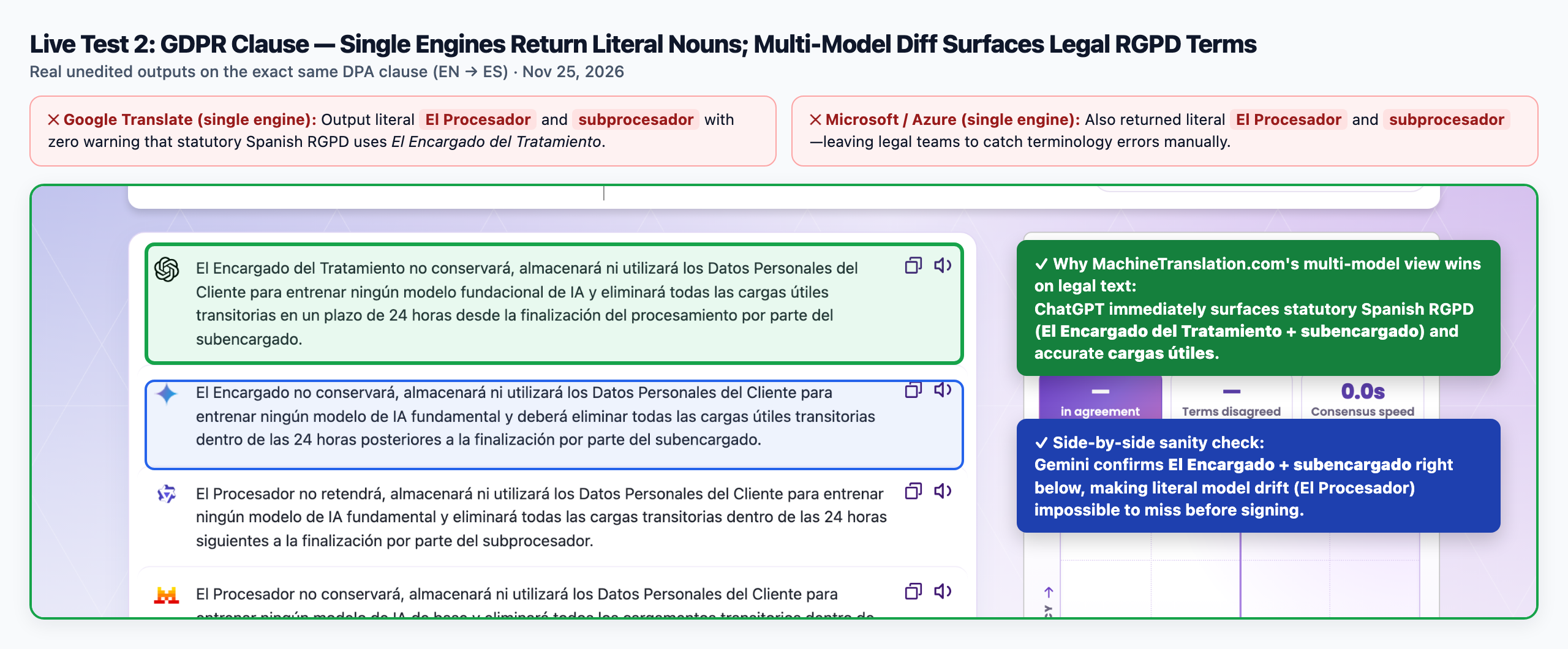
Right inside one screen, ChatGPT produced the exact statutory RGPD phrasing (El Encargado del Tratamiento, cargas útiles transitorias, subencargado) and Gemini backed it up directly underneath (El Encargado + subencargado), making literal drift from single models obvious in two seconds. Practical tip: on regulated legal clauses, always scan the stacked model cards right below the top consensus bar—seeing where models diverge on statutory terms is the main reason multi-model verification beats single-engine MT.
The Three DeepL Alternatives Worth Shortlisting
1. MachineTranslation.com: Best Multi-Model Workbench for Legal, Docs & High-Stakes Copy
Built by ISO-certified translation agency Tomedes, MachineTranslation.com solves the single-engine blind spot that DeepL, Google, and Azure all share. Instead of betting a contract or product launch on one black box, you compare up to 22 AI models side by side in roughly 1.5 seconds and escalate tricky documents straight to human linguists.
- Plans & capabilities: $19/month Pro (includes 2,000 words/month of human review, 70 MB formatted file translation, API access, and an MCP connector at
developer.machinetranslation.com/mcp), $190/month Team (5 to 15 shared seats), a $9 1-day Unlimited Pass for ad-hoc batches, and Tailored enterprise plans. - Privacy & ZDR: Its Trust documentation commits to TLS 1.3, AES-256 encryption, zero data retention, no AI model training, and a dedicated Secure Translation mode hosted inside Tomedes' AWS US-East environment.
- Good to know for planning: Anonymous free tests cap at 60 words (use the
$9day pass or$19/moPro for full documents), Key Terms support up to 10 priority terms, and Secure Mode currently runs on AWS US-East rather than EU servers.
2. Azure AI Translator: Best Default When You Are Leaving DeepL Over API Cost
DeepL restructured its API plans in 2026: the recurring free tier became a one-time 1M-character Developer credit, and the Growth tier starts at $26/month (US annual) or €23.80/month (EU annual) plus per-character usage, capped at 50M characters/month before Enterprise sales.
Azure AI Translator charges a flat $10 per million text characters on Standard S1 ($15/1M for formatted documents) with 2M free characters every month on F0, EU data residency regions, and zero storage or training guarantees by default on paid tiers.
What about the other two hyperscalers? Amazon Translate ($15/1M standard, $30/1M real-time .docx, $60/1M Active Custom Translation) makes sense if your security team already standardizes on AWS IAM, PrivateLink, and S3 batch jobs. Google Cloud Translation v3 ($20/1M, or $18/$16 on 1-year/3-year Gemini Enterprise Flexible Savings) costs twice Azure on text, so pick it mainly for broad non-European language pairs or predictable $0.08/page PDF/DOCX billing.
3. Frontier LLM APIs (Claude / GPT): Best Pipe for UI Code and Brand Voice
For engineering teams localizing JSON resource bundles, Markdown docs, or product microcopy in CI/CD, calling Claude or GPT APIs directly with a system-prompt glossary and strict JSON schema output costs pennies per million characters and keeps ICU syntax intact. Just make sure you route confidential files through commercial ZDR API tiers (never consumer web chat) and keep in mind that raw LLMs do not preserve Word or PowerPoint layouts natively.
Monthly Cost & Scope Comparison (10M vs. 100M Characters)
| Option | 10M Chars / Mo | 100M Chars / Mo | Best Fit & Key Scope Note |
|---|---|---|---|
| MachineTranslation.com | $19/mo Pro / $190/mo Team | Tailored enterprise quote | Multi-model diff + 70 MB docs + human review; 10-term Key Term limit & AWS US-East Secure Mode |
| Azure AI Translator (S1) | $100/mo (text) / $150 (docs) | $1,000/mo | Lowest cloud API unit cost + EU residency; clean on ICU JSON, pair with glossary for legal nouns |
| Amazon Translate | $150/mo (text) | $1,500/mo (text) | Native AWS IAM/S3 pipelines; real-time .docx is $30/1M, custom models $60/1M |
| Google Cloud v3 | $190/mo (500K free) | $1,990/mo ($1,600 on 3-yr commit) | Non-EU languages & $0.08/page PDF billing; 2x Azure unit price on raw text |
| DeepL API (Baseline) | around $276/mo (Growth base + usage) | Enterprise quote (50M/mo cap) | Smooth EU prose & 2,000 glossaries; needs XML tag wrappers for raw UI JSON |
Bottom Line: When to Stay vs. When to Switch
Stay on DeepL if you translate under 10M characters a month of clean European marketing prose, already maintain hundreds of DeepL glossaries, and need strict EU residency out of the box.
Switch to MachineTranslation.com when you want multi-model verification, formatted file translation, and optional human review to catch silent legal or UI errors before publishing. Switch to Azure AI Translator once your API bill crosses 25M+ characters a month, or wire Claude/GPT APIs directly into your CI/CD pipeline for product UI strings.